


























AI tools don't rank your website. They either cite it or skip it entirely. This guide breaks down 9 strategies to make your website the source AI models want to cite, from content structure and schema markup to off-site mentions and AI visibility tracking.
TL;DR
- LLM SEO aims to make B2B content understandable, trustworthy, and easily cited by AI, rather than merely ranked in search results.
- Structure pages with question-based headings, immediate concise answers, short paragraphs, lists, tables, FAQs, and clear metadata to improve extractability.
- Publish original research, case studies, expert insights, and specific data because AI models favor distinctive information over generic summaries.
- Combine accessible technical foundations, schema markup, credible off-site mentions, and monthly prompt testing to strengthen and measure AI visibility.
How to optimize a B2B website for AI search?
When you ask an AI chatbot to "search the web," it is not just answering from its training data. It is calling a separate search system, pulling live results, scanning the pages, and then deciding which sources to quote in its answer.
Most marketers know that much.
What they don’t know is how much of this pipeline depends on traditional search engines and how much has been built on top of them. The discovery phase, where the AI figures out which pages might be relevant, runs on the same infrastructure that Google uses.
But here is where it gets different from regular SEO. Once the AI has a shortlist of pages, it enters the retrieval phase. It reads the content, chunks it into passages, and scores each chunk for how well it answers the user's actual question. The model picks the page that gives the clearest, most quotable answer to the question. If your content is a wall of marketing copy with no structure, the AI moves on to a competitor's page.
What is LLM Optimization?
LLM optimization in one sentence is making your content the one AI pick when it has 20 options in front of it. It’s the process of structuring your site’s content so that AI models understand it, trust it, and use it when generating answers.
The industry has not settled on one name yet. LLM SEO, AEO (Answer Engine Optimization), GEO (Generative Engine Optimization). Different labels, same goal. You want your B2B website to be cited by AI as an the authoritative source when a buyer asks a question about your category.
How LLM SEO differs from traditional SEO?
Traditional SEO gets you ranked. LLM SEO gets you cited. Traditional SEO focuses on ranking high in search engine results (blue links), whereas LLM/AEO focuses on being the source that an AI cites or summarizes in its answer.
This requires a mindset shift. Unlike search engines, LLMs don’t “rank” your page; they interpret it. There is no page two in an AI chat response, content is either used or ignored. Models decide in seconds if your page is clear, relevant, and authoritative enough to incorporate into an answer.
Key differences between SEO and AEO:
Why AI search visibility matters for B2B marketers
AI search is already one of the highest-intent acquisition channels out there. The average AI search visitor is more valuable than a traditional organic visitor. For many businesses, brand discovery is already happening inside LLMs when ChatGPT, Perplexity, and Google Gemini cite your brand as the source of truth. One B2B SaaS company tracked $100,000 in monthly revenue from ChatGPT referrals.
For B2B specifically, the stakes are higher. Your buyers research for weeks, involve multiple stakeholders, and increasingly ask ChatGPT "what are the best tools for X" before visiting any website. When an LLM names your product as the best solution, it carries implicit trust and users often skip comparison shopping entirely and go straight to your site.
Making your website AI-ready is becoming as important as traditional SEO optimization, if not more.
How to optimize your B2B website for AI search? (9 strategies)
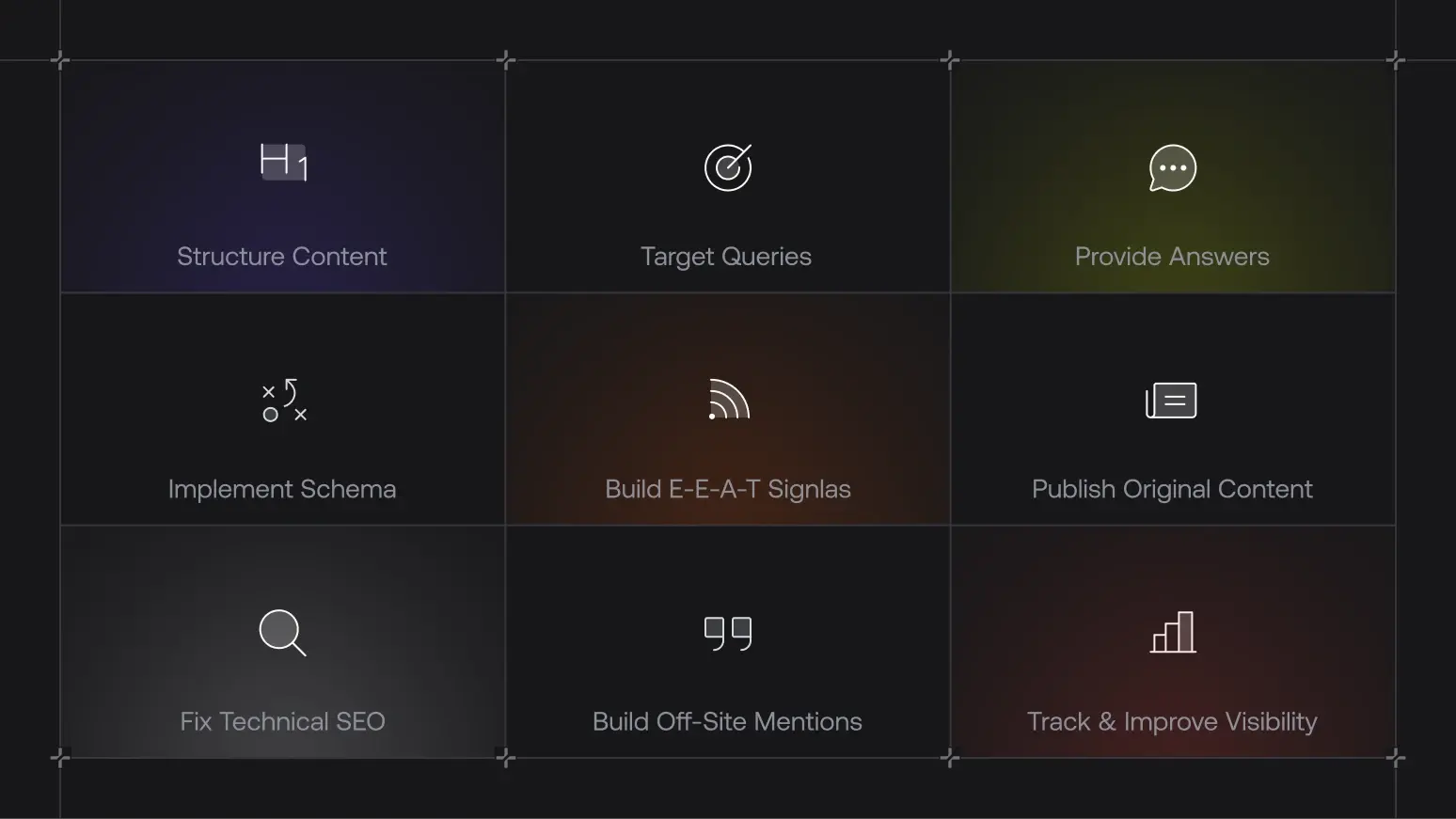
Optimizing for LLMs is a mix of content strategy, technical SEO, and digital PR. It is a hybrid approach: part writing for an AI audience, part making sure your site is technically accessible, and part building your brand across the web. Here are the most important strategies with examples.
1. Clear up your AI content structure
The AI needs a clean, self-contained chunk it can quote, ideally in the first two sentences under a relevant heading. To make this happen:
- Use clear, hierarchical headings (H1, H2, H3) to organize topics logically. Every page should have one H1, then use H2/H3 subheadings for sections. This helps both humans skim and AI parse your page
- Phrase subheadings as questions your audience might ask (for example, "What is X?" or "How does Y work?"). This mirrors how users prompt LLMs and increases the chance the AI lifts your content as the answer
- Provide a concise answer immediately after each heading, then elaborate. Think Wikipedia: lead with the key fact, then add depth. Wikipedia gets cited by AI constantly, and the format is a big reason why
- Write short paragraphs of two to four sentences. Long walls of text are hard for models and people to process. Bite-sized information is more quotable
- Use bullet points, lists, and comparison tables wherever they make information easier to scan. An LLM can easily extract a list of "key benefits" or a table of specs from your page
- Add summary or FAQ sections at the end of long pages. LLMs frequently pull from these when citing sources
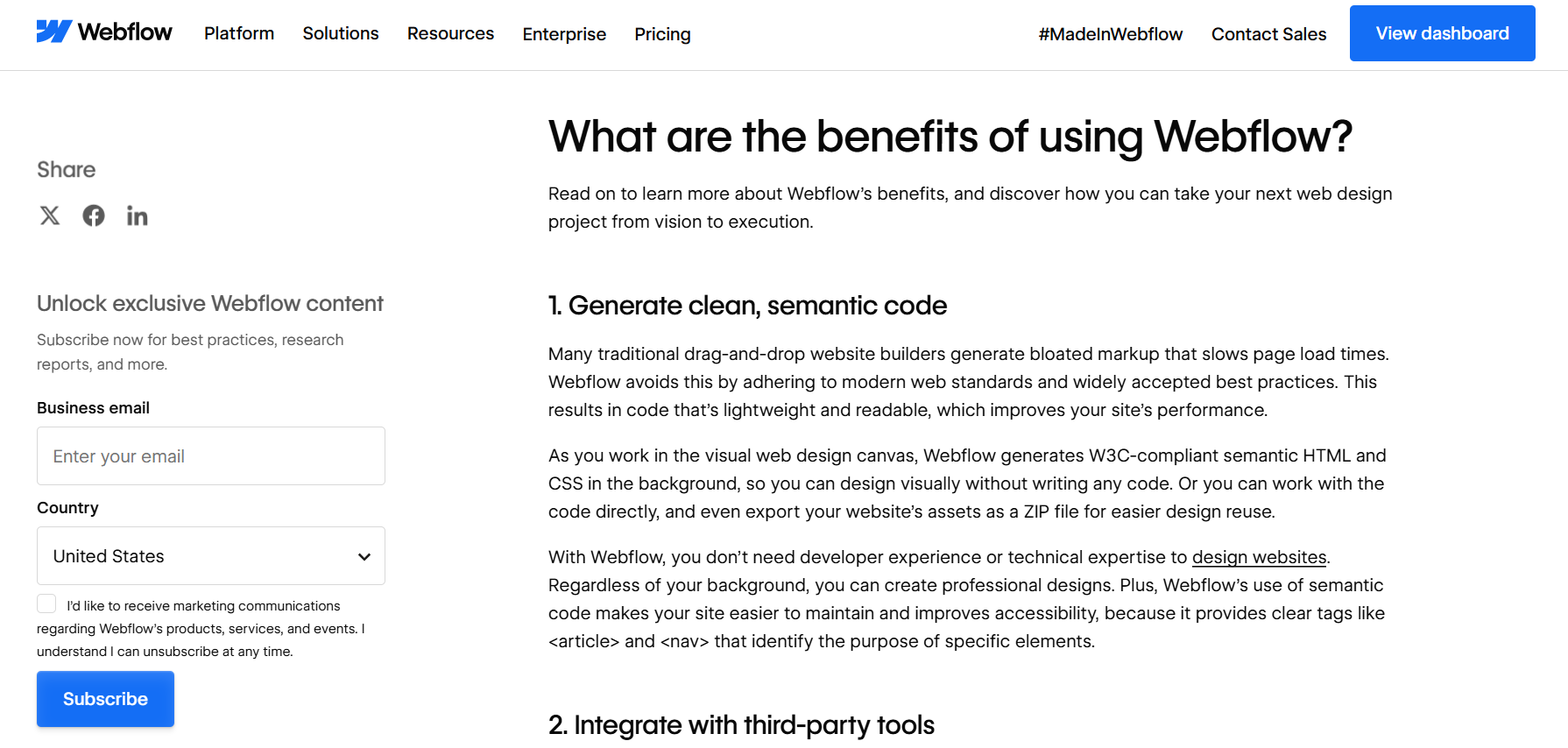
Instead of a generic section titled "Our Solution Advantages" with a lengthy paragraph, use a heading like "What are the benefits of [Your Solution]?" followed by a two-sentence answer and then a bullet list. That Q&A format directly aligns with how AI presents information to users.
A strong example of this structure in action comes from Webflow, where they use a direct, question-based heading: “What are the benefits of using Webflow?”
2. Provide direct answers AI search can quote
When someone asks an AI a question, the model is looking for a portion of a webpage that directly answers it. To be that quoted snippet:
- Lead with the answer. If the heading is "What is LLM SEO?" define it in the first sentence. For example: "LLM Optimization is the practice of structuring content so AI language models can understand, retrieve, and cite your website when answering relevant questions."
- Include statistics and specifics whenever possible. Concrete facts like percentages, dollar figures, and time frames make compelling snippets and give the AI confidence in your content
- Format for extraction: ordered lists for processes, bullet lists for benefits, tables for comparisons. If someone asks for a comparison of your product versus a competitor, a clear table or bullet list of differences increases your chance of being cited
- Optimize meta tags to be descriptive. Sometimes AI models use title tags and meta descriptions as quick summaries when building answers
This approach also improves human UX. Busy B2B buyers scanning your site appreciate quick, clear answers just as much as AI models do.
3. Target conversational queries for LLM optimization
LLM SEO is about targeting the actual questions people type into AI tools, not only keywords.
- Use tools like AlsoAsked, AnswerThePublic, or ask ChatGPT itself what questions people have about your topic. Identify the 20 to 50 questions a B2B decision-maker would ask, things like "Which Webflow agency is best for enterprise SaaS?" or "How do I improve SaaS website conversion rate?"
- Dedicate sections or entire posts to answering those questions in depth, using conversational language your audience uses when talking to an AI
- Cover multiple facets of each question. Under "How to optimize my site for AI search?" you might cover technical steps, content steps, and measurement as sub-sections. Models appreciate comprehensive answers that address different angles
- Include relevant synonyms and variations naturally. LLMs work on semantics, so weaving in "AI search optimization" and "answer engine optimization" alongside "LLM SEO" helps the model see your relevance regardless of phrasing
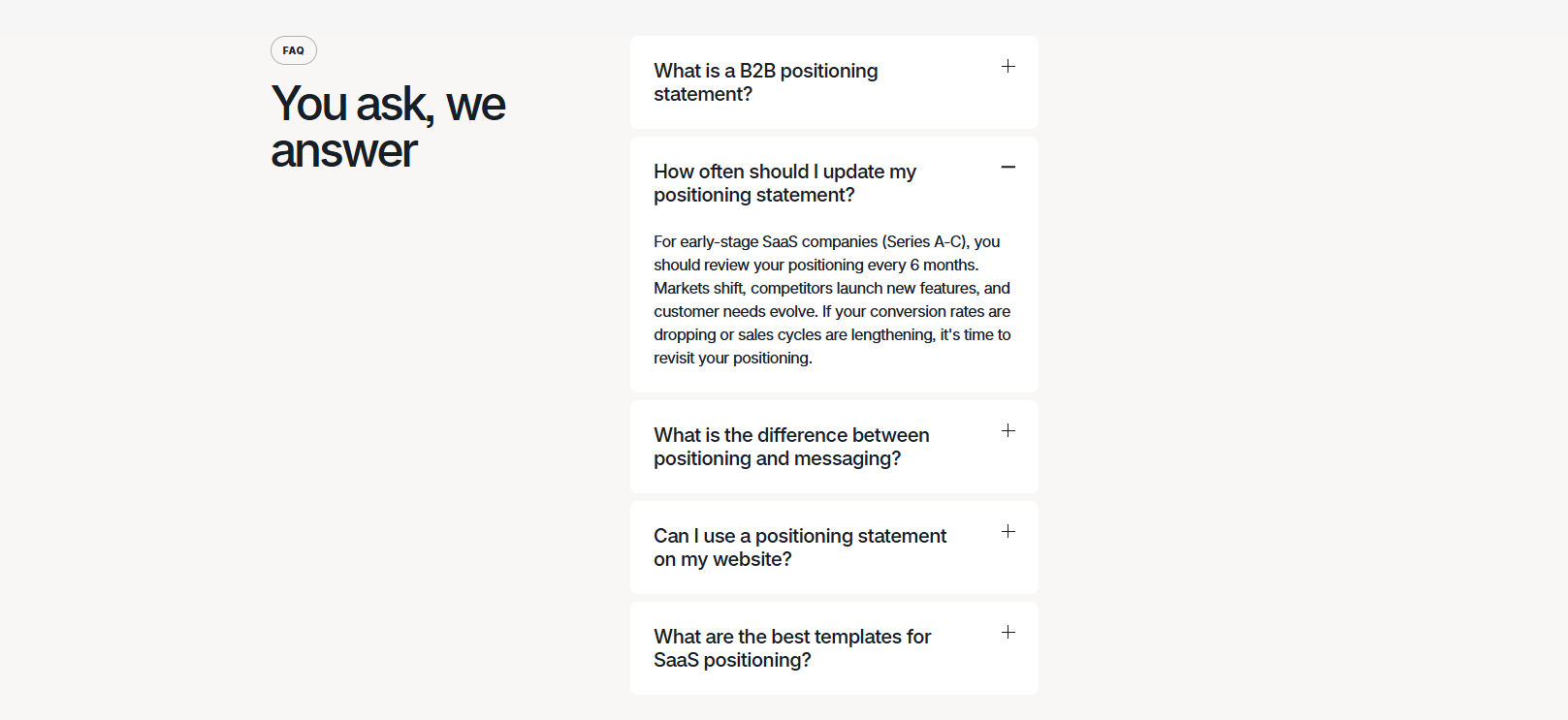
Think of your FAQ page as a goldmine. A well-structured FAQ with real questions acts as ready-made Q&A content for LLMs. Each entry could be the exact snippet an AI uses. Glossary definitions and knowledge-base style content work the same way, especially if they are clearer than what competitors offer.
Apricot Studio’s FAQ section is a strong example of AI-ready content structure.
4. Implement schema markup for LLM SEO
Structured data helps both search engines and AI models understand your content with precision. In AI search, schema is not a bonus, it is the blueprint models use to understand you.
- Add FAQ Page schema for Q&A sections, Article schema for blog posts, Organization schema for company info. These machine-readable JSON-LD blocks give AI a structured map of your content
- Include dates and author metadata. An AI looking for current information will trust a recently updated page over one from three years ago with no date
- Fill out Open Graph tags and meta descriptions that align with the content. LLMs sometimes draw from these when summarizing pages
- Use descriptive alt text on images. If you have a chart showing "ROI increase after website redesign," mention the key stat in the alt text. Future multimodal AIs will read it
- Maintain clean, readable URLs and consistent site architecture.
If you are on Webflow, you can embed custom JSON-LD in page settings and upload an llms.txt file through SEO settings.
5. Build E-E-A-T signals for AI search visibility
LLMs are more likely to cite content from a credible, authoritative source. The same E-E-A-T signals that matter for Google matter even more when an AI is deciding which source to quote.
- Include author names and bios with real credentials on blog posts and guides. AIs find content more trustworthy when an expert is clearly accountable for it
- Cite reliable sources within your content. Referencing a Gartner report or known industry study places your page in a credible information chain that AI models recognize
- Earn contextual mentions from authoritative websites. Research shows named mentions in the right context matter more for LLMs than pure backlinks
- Keep content updated and accurate with visible "last updated" dates. If your blog post on "AI in marketing" has not been touched since 2021, an AI will skip it for a 2025 article on the same topic. Audit your top content quarterly
- Include customer quotes, case studies, and testimonials where relevant. Experts speculate that quotes from well-known figures can positively influence findability in LLM results
This is where our SEO optimization work overlaps most with LLM SEO. We help B2B companies build credibility signals that both Google and AI reward.
6. Publish original content that earns LLM citations
AI models have already read the generic version of every topic. If your post says the same thing as 50 others, the AI has no reason to cite yours. Models gravitate toward content that adds something new.
- Conduct or showcase original research with proprietary data. Unique data points make your content one-of-a-kind and citation-worthy. LLMs prioritize original data and insights
- Share detailed case studies with firsthand results an AI cannot get elsewhere. If someone asks "How do I improve Y metric?" the model might cite your case study as a real example
- Develop unique frameworks or terminology. If you coin a method and explain it clearly, people and AI alike will reference it as the original source
- Invite expert contributions. Interview an industry expert or get a specific quote for your article. This creates something unique and experts often share content that features them, earning additional mentions
One case study showed that after implementing such content strategies (comprehensive comparison pages, original research, etc.), a B2B SaaS saw a 187% increase in ChatGPT citations and became a top recommendation on Perplexity.
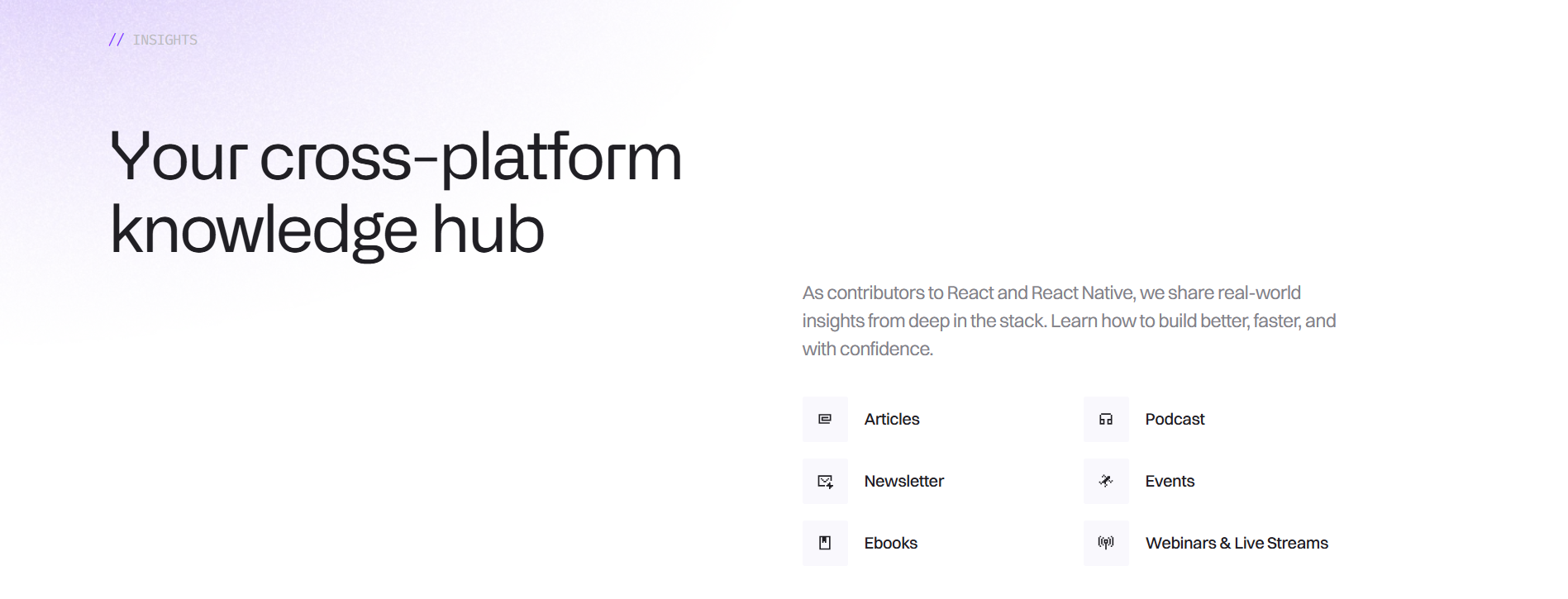
A strong example of credibility-driven content comes from Callstack’s Insights section. Their long-form technical reports and research-driven articles consistently include named authors, visible expertise, implementation experience, and industry context.
7. Fix technical SEO for AI crawlers
None of the content strategies above matter if AI crawlers cannot access your site.
- Allow AI crawlers in robots.txt. Bots like GPTBot (OpenAI) and OAI-SearchBot need access to your pages. Check that you are not accidentally blocking them
- Keep an updated XML sitemap submitted to Google and Bing
- Many AI crawlers read raw HTML and miss content loaded via JavaScript. In Webflow, most content is static HTML once published, which is ideal
- Use HTTPS and fast hosting. Site speed affects crawl efficiency, and LLMs scanning the web operate within time and resource limits. The same things that help Googlebot help AI models too
- Implement an llms.txt file at your root. Think of it as a curated index that tells models where high-value content lives. Your llms.txt might summarize your SaaS and list your most important pages (API docs, pricing, case studies) in an AI-readable format
- Avoid blocking content behind logins. LLMs cannot access anything that is not public
Monitor your server logs to see if AI user agents are hitting your site. If GPTBot crawls a certain section frequently, those pages may already be candidates for AI citations. And do not forget mobile optimization and accessibility.
8. Build off-site mentions for LLM optimization
LLMs build answers by drawing from many sources. If your blog says "Our SaaS increases productivity by 50%" and a respected site like Forbes also mentions your company's impact, the AI is much more likely to include that fact.
- Be active on Reddit and Quora, among the most cited domains in AI-generated answers. If someone on Reddit asks for "recommendations on SaaS web design agencies," a thoughtful answer that mentions your agency without being overly promotional can plant a seed.
- Get listed on relevant directories and review sites like G2, Capterra, Crunchbase, and Wikipedia. It is not just backlinks but being mentioned by name in the right context on authoritative sites that matters
- Pursue PR and thought leadership. An AI might answer "Who are the leaders in [X] space?" by citing a TechCrunch article or Gartner report that lists companies. Make sure you are in those articles.
- Encourage user-generated content and discussions. Prompt happy customers or partners to share their experiences publicly
- Build a digital footprint across slides, YouTube videos with transcripts, press releases, and guest articles. If you have a YouTube video titled "What is Growth Design?" with a thorough transcript in the description, an AI might learn from that text as well
Notion, ClickUp, and Slack are strong examples of how off-site mentions reinforce AI visibility. These B2B brands do not rely solely on their own blogs to claim authority. Their visibility is strengthened by repeated, contextual mentions across independent platforms.
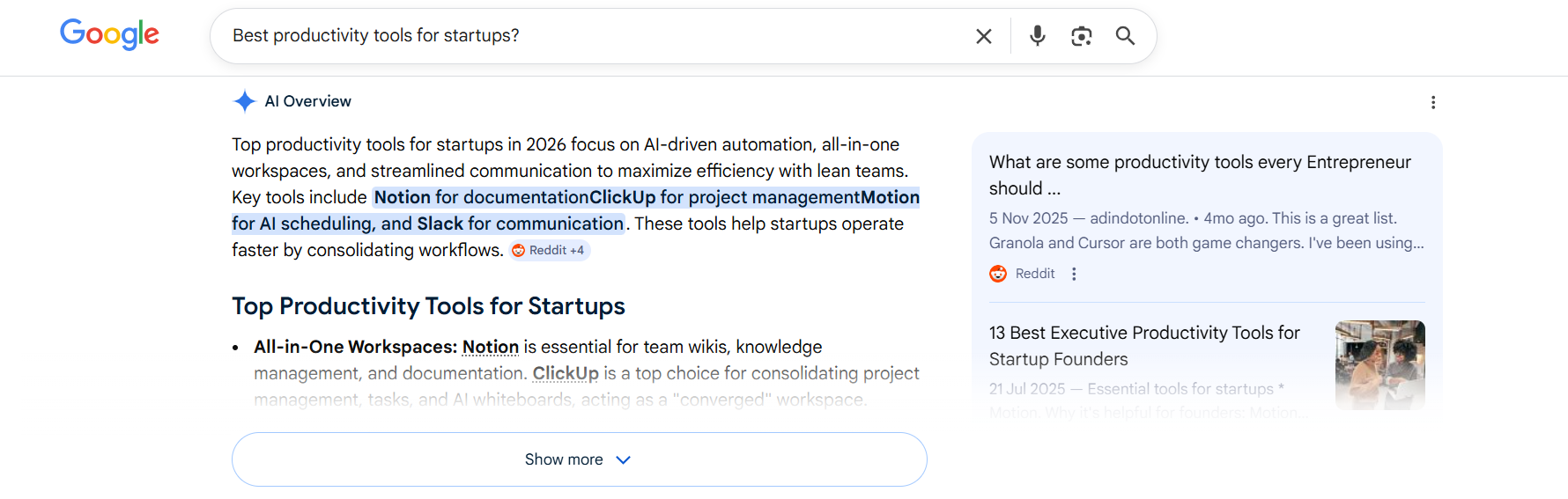
If you search: “Best productivity tools for startups” those brands appear because they have:
- Thousands of reviews on G2
- Listings on Capterra
- Coverage in editorial articles by TechCrunch
- Frequent recommendations in Reddit discussions
- Appearances in YouTube comparison videos with transcripts
These are independent signals. AI models draw from multiple corroborating sources.
9. Track and improve your AI search visibility
How do you know if all this is working? Just as with SEO, you’ll want to track and tweak your AEO strategy:
- Manually test AI prompts by running buyer queries across ChatGPT, Perplexity, and AI Overviews monthly. Use prompts a customer would use, things like "Best Webflow development agency for B2B SaaS". Keep a spreadsheet of 20 to 30 prompts and test them.
- Analyze the gaps. If a competitor gets cited where you do not, dig into why. What format or information does their content have that yours lacks? Maybe you need a comparison page for X vs Y because your competitor has one and the AI is citing it.
- Use AI visibility tools monitor which prompts mention you and which cite competitors. These tools provide quantitative data like "your brand appeared in 8% of answers about [topic] this month"
- Check your referral traffic for AI-related sources. Perplexity shows as a referrer. Bing Chat traffic appears in analytics. One CMO reported that traffic from ChatGPT converted at 30% for one of their clients
- Ask your customers. Add "AI search tool" to your "how did you hear about us" form. This qualitative data can be powerful for convincing stakeholders that AI optimization has real ROI
Make it a habit to review your AI visibility monthly and keep optimizing.
The 30-60-90 day plan
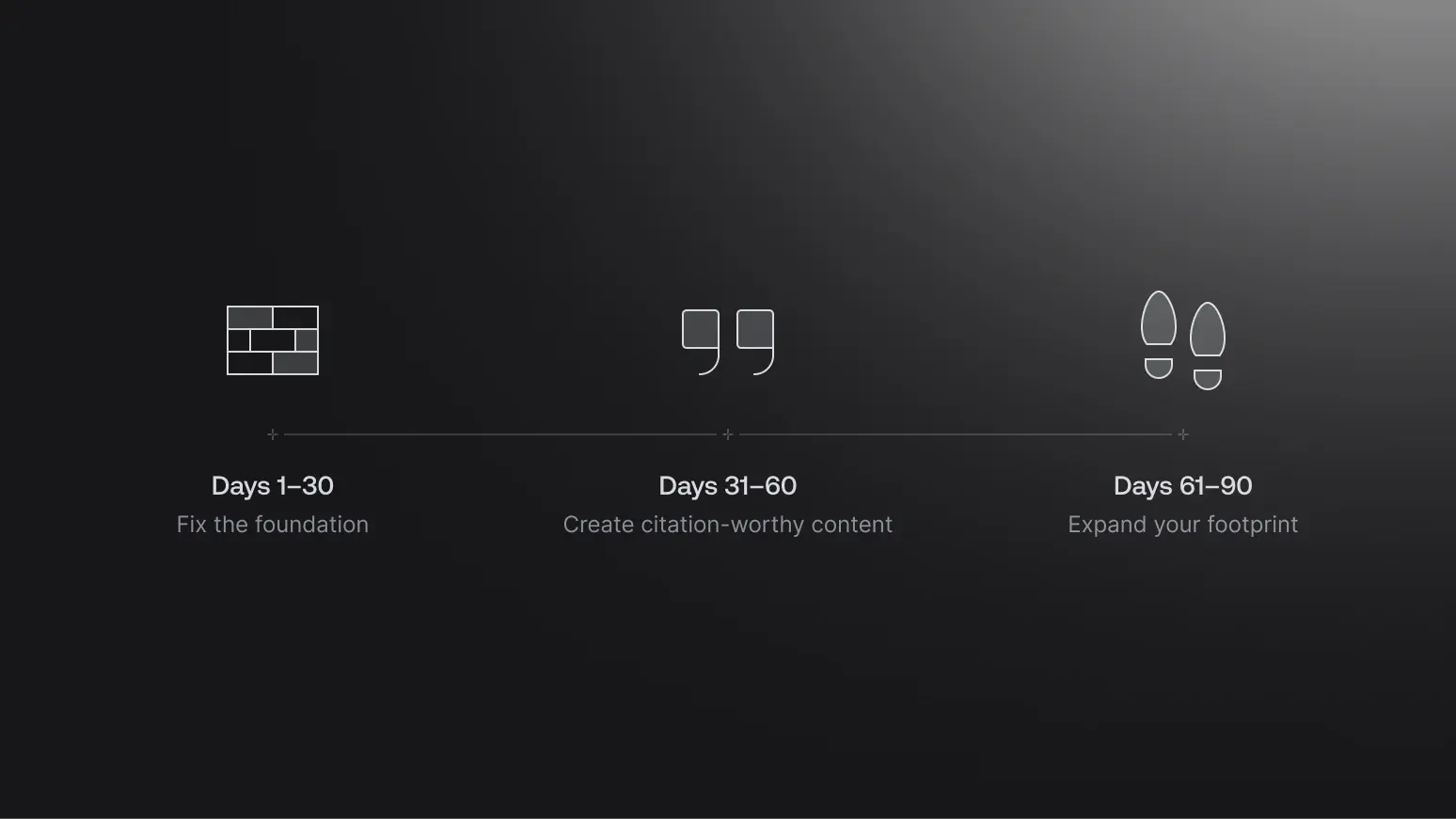
Days 1 to 30: Fix the foundation. Audit your top 10 revenue pages. Add question-based headings and direct answers in the first sentence of each section. Implement FAQ schema. Update "last reviewed" dates. Check robots.txt for AI crawler access. Build your prompt tracking spreadsheet.
Days 31 to 60: Create citation-worthy content. Build comparison pages for your product versus alternatives. Publish original research or case study data with real numbers. Add integration and use-case pages that answer specific buyer questions. Expand structured data across the site.
Days 61 to 90: Expand your footprint. Launch a digital PR push to earn mentions on high-authority sites. Get active on Reddit and LinkedIn with helpful, non-promotional content. Start tracking AI visibility monthly with dedicated tools. Review results, find the gaps, and iterate.
From SEO to AEO: adapting your B2B website for AI search
The principles that made your website rank on Google have not stopped working. Quality content, clear structure, and credibility are still the foundation. What has changed is where your content needs to show up and how it gets selected.
AI tools do not browse a list of ten results and pick one. They scan, extract, and cite. If your content is structured so that a model can confidently quote it, you get mentioned. If it is not, your competitor does. There is no middle ground in AI search. You are either in the answer or invisible.
Design every page so that a model could ingest it and confidently recommend your product to someone. Do that, and you position your company to grow through both human visitors and AI recommendations. AI-earned authority compounds the same way SEO authority did for years. The difference is that most of your competitors have not started yet. That window will not stay open.