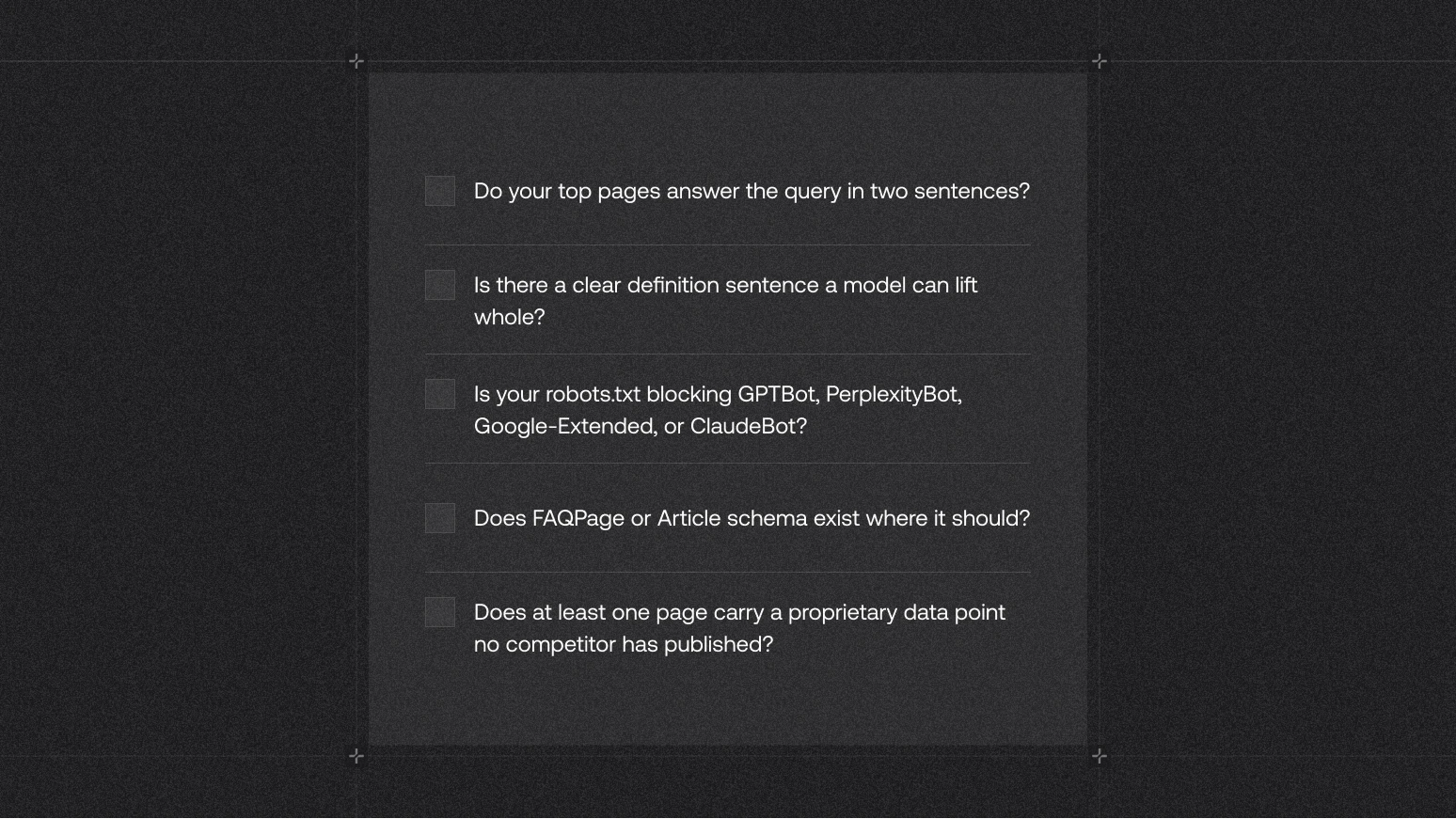


























Getting cited by ChatGPT, Gemini, or Google's AI Overviews comes down to structure, originality, and technical crawlability. This post covers eight ways to get cited, plus a quick audit for your existing pages.
TL;DR
- B2B websites can improve AI citation visibility through answer engine optimization, which emphasizes clear definitions, crawlability, authority, and distinctive information.
- Answer each heading immediately, use genuine H2 and H3 headings, and limit paragraphs to one claim so models can extract passages cleanly.
- Strengthen credibility with named experts, specific project details, and proprietary insights drawn from product analytics, support tickets, sales calls, or onboarding data.
- Support discovery with validated FAQPage and Article schema, maintain important pages, contribute useful community answers, and separately measure AI-referred traffic quality.
Why B2B SaaS content gets skipped by AI answers
B2B SaaS teams are starting to ask a new SEO question: how do we get our product to show up when someone asks ChatGPT, Perplexity, or Gemini about our category?
A common question from founders is whether AI recommendations are just training-data luck, or something you can actually influence. In our experience, you can influence it.
A page can hold its position, sometimes even climb, and organic clicks still drop. We've watched this show up in client Search Console accounts over the last eighteen months: the traffic is going to an AI-generated answer that pulled the content straight off the page and never sent the visitor anywhere.
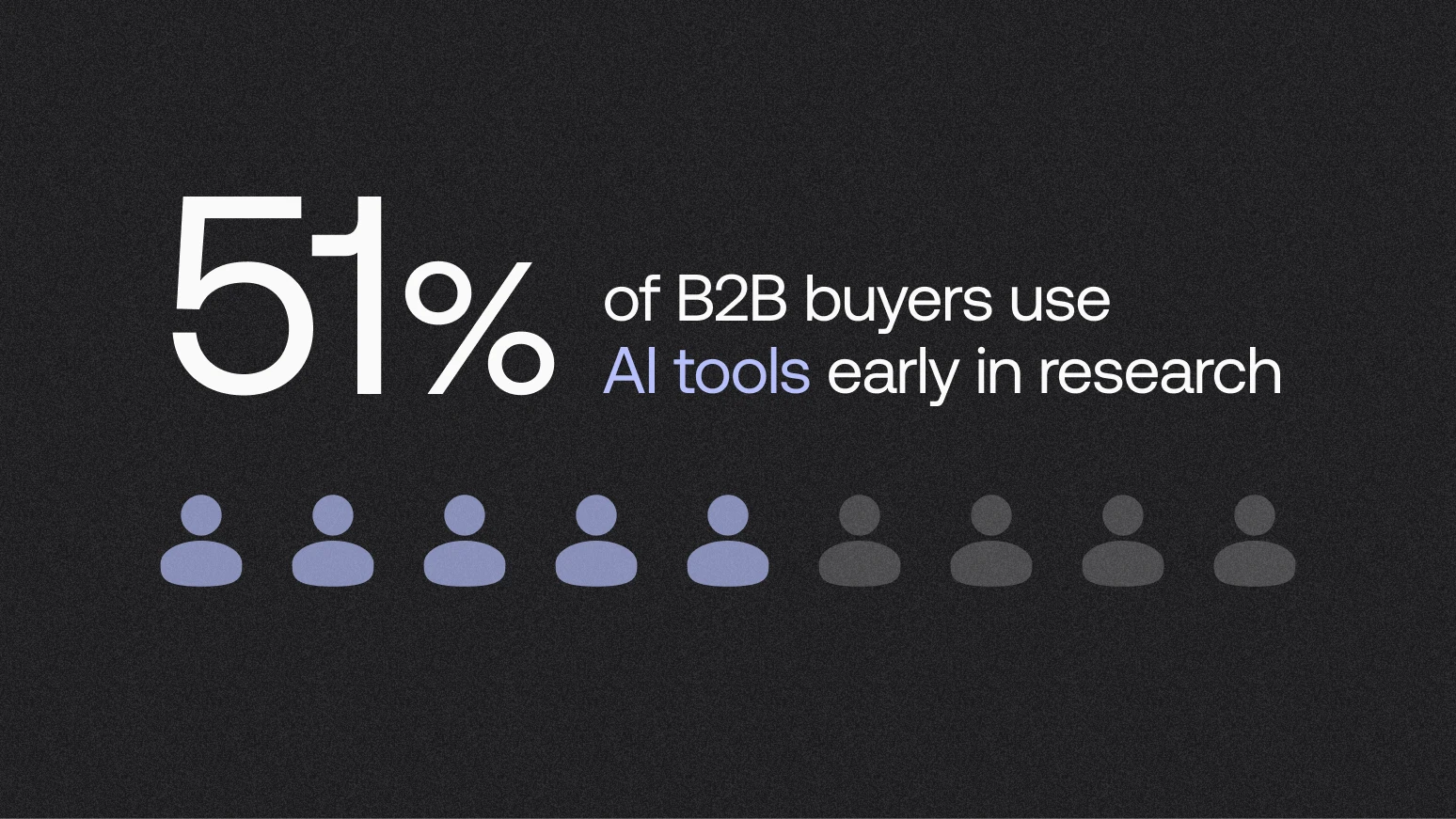
For B2B SaaS, this matters more than most categories. 51% of B2B software buyers now start their research with an AI chatbot more often than with Google, up from just 29% a year earlier, and 85% think more highly of a vendor an AI chatbot recommends. Getting cited visibly moves which vendors make the shortlist.
A few things decide whether AI chatbots and answer engines like ChatGPT, Gemini, Claude, Perplexity, Copilot, and Google's AI Overviews cite your content instead of a competitor's.
What is answer engine optimization (AEO)?
Answer engine optimization is the practice of structuring content so it gets cited inside a generated answer instead of only ranked in a list of links. Classic SEO and AEO share the same underlying signals, like keywords, backlinks, and authority, but AEO puts more weight on definitional clarity, technical crawlability, and content a model cannot synthesise from five other sources.
The two disciplines can succeed or fail independently. You can rank number one on Google and still be left out of the AI answer for that exact query, because models weigh a different mix of signals. Scalerrs took Morgen, a calendar app, from 9,000 to 29,000 organic clicks a month in four to five months by restructuring for both classic and AI search at once, and their case study documents the client's on-record quote confirming the result.
Answer engine optimization is the practice of structuring content so it gets cited inside a generated answer instead of only ranked in a list of links. Classic SEO and AEO share the same underlying signals, keywords, backlinks, authority, but AEO puts more weight on definitional clarity, technical crawlability and content a model cannot synthesise from five other sources.
The two disciplines can succeed or fail independently. You can rank number one on Google and still be left out of the AI answer for that exact query, because models weigh a different mix of signals. Scalerrs took Morgen, a calendar app, from 9,000 to 29,000 organic clicks a month in four to five months by restructuring for both classic and AI search at once, and their own case study documents the client's on-record quote confirming the result.
8 ways to get B2B SaaS content cited in AI answers
These eight levers cover structure, originality, and the technical side of getting picked up. None of them require rebuilding your site. Run the audit at the end to find your gaps.
1. Answer the exact question in the first two sentences
AI chatbots and answer engines scan a section for the one sentence that answers the query, then move on. A direct answer buried in paragraph four, after three paragraphs of scene-setting, has already lost its chance to get quoted by the time the model reaches it.
When the question is a "what is X" type, that first sentence needs to define the term cleanly and stand on its own, with no pronoun pointing back to a previous paragraph. Write it last, once the section already exists, so it reflects your actual argument instead of a generic definition copied from a competitor.
Real H2 and H3 headings matter just as much as that opening sentence. This is exactly the kind of structural gap a content strategy pass is built to catch before the page gets written. A model needs the heading to find the section before it can lift the sentence inside it.
How to apply it: cover everything after the second sentence of a section and check whether a stranger, with no other context, now knows the answer the heading promised. If not, you wrote the section for a reader who was always going to scroll past it.
2. Put one claim in each paragraph
A paragraph that stacks three ideas together is hard for a model to lift cleanly, because it has to guess which sentence is the actual point and which two are supporting detail. One paragraph, one claim, gives the model a clean unit to extract and gives the reader the same clarity.
Split the setup into its own paragraph if it is doing real work, or cut it if it is not. A short paragraph is the format the extraction rewards, even when it looks thin sitting next to a longer one above it.
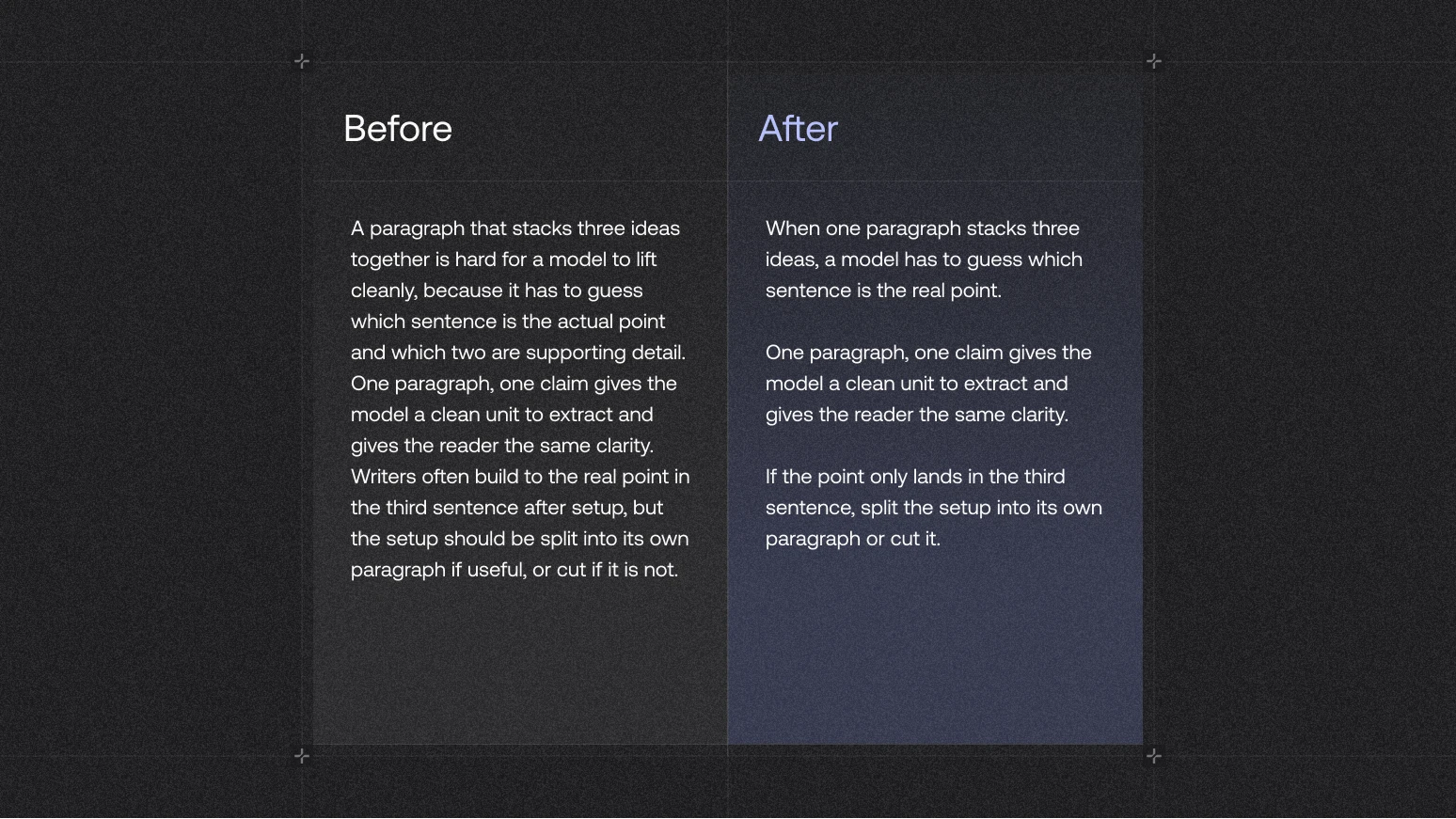
How to apply it: open any published section and count how many distinct claims sit inside the longest paragraph. Two or more means the paragraph should split, even if the result looks shorter than what an editor would normally wave through.
3. Feature named expertise
A generic "our team has ten years of experience" reads weak, to both a human editor and a model weighing which page to cite. A paragraph attributed to the specific person who ran the project, with a detail only that person could know, reads stronger.
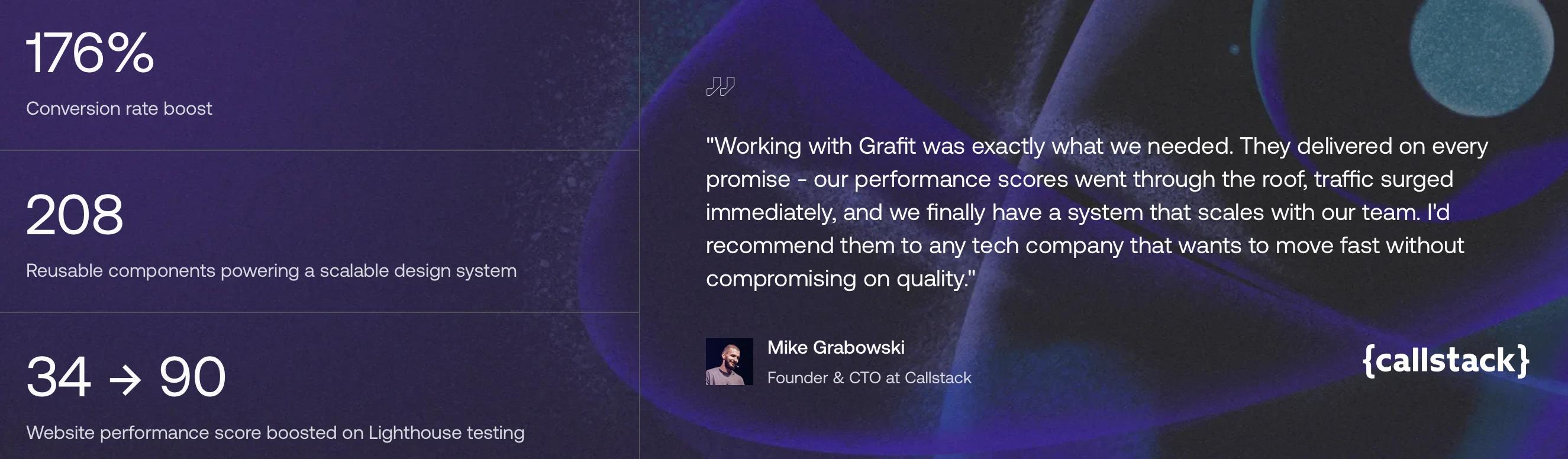
Callstack's case study is the template worth following, and it earns that by being specific: a Lighthouse score that moved from 34 to 90, load time cut from 4.2 to 1.1 seconds, 65.7% more organic traffic, a 176% lift in conversion rate. That level of detail is what makes a page worth citing over a competitor's vaguer version of the same claim.
4. Publish something a model cannot rehash from ten other pages
ChatGPT and its peers handle the evergreen, already-answered version of most B2B questions competently. What none of them can do is generate your proprietary usage data or an opinion nobody else has stated in public.
How to apply it: ask product, support, and customer success each for one number nobody outside the team has seen. Pick the one most tied to the page's topic and commit to the actual figure in the copy, specific and unrounded, even when that feels riskier than a vague version everyone can agree on.
5. Show up where models already look for consensus
Community platforms, Reddit in particular, now surface in positions that used to belong to blog posts, and the same signal shows up in what AI models treat as trustworthy.
A useful, specific answer with no pitch attached earns the credibility that eventually gets referenced, both by other people in the thread and by whatever later retrieves it.
6. Mark up the page so a model does not have to guess
FAQPage schema on any genuine question-and-answer content, and Article schema with an author and a publish date on editorial pages, give a model an explicit, machine-readable shortcut instead of forcing it to infer structure from formatting.
This falls to a developer, and it gets skipped for exactly that reason: it never lands on a copywriter's list, and a developer without a specific ticket for it has no reason to think about it. A developer can usually add both schema types to an existing template in an afternoon, and the fix applies to every page built on that template going forward.
How to check it: run a handful of key pages through Google's Rich Results Test and confirm the FAQPage and Article schema actually pass validation. A malformed schema block that merely sits in the source counts the same as having no schema block at all.
7. Keep key pages fresh
AI tools are more likely to pull from pages that look fresh and maintained. A page can still be accurate, but if it has not been reviewed in a year, it starts to look less reliable, especially in B2B SaaS where pricing, product features and category language change quickly.
You do not need to rewrite every page just to make it look new. Start with the pages that already bring in traffic or support buying decisions, and treat them as part of your regular content refresh. Review what has changed, then update the examples, claims, screenshots, and internal links
When refreshing a page, check whether you need to update:
- product screenshots or demo visuals
- pricing or packaging information
- feature names and descriptions
- customer examples, logos, or testimonials
- comparison points against competitors
- stats, benchmarks, and market claims
- internal links to newer pages or blog posts
- FAQ answers and schema
- wording around the category, especially if buyers now describe the problem differently
8. Track the quality
Being mentioned by AI is one thing. Getting the right people to click is another.
AI-referred visitors may behave differently from standard organic traffic. Some will be more qualified because the answer has already helped them understand the problem. Others may just be exploring with no buying intent yet.
Track these visits separately and compare them with your usual organic and paid traffic. Look at conversion rate, demo requests, form fills, time on page, and which pages they visit next. The goal is not just to get mentioned in AI answers, but to understand whether those mentions bring visitors who are likely to become pipeline.
How to check it: filter your analytics for referral sources like chatgpt.com, perplexity.ai, and copilot.microsoft.com. Then compare their conversion rate and engagement against your organic and paid baselines.
Before you write the next page
Run these checks before publishing anything new, starting with your ten highest-traffic pages. They already carry topical authority a new page would need months to build.